BAT Agrar & Co. KG.
How I turned a legacy platform struggling to function into a €32.5 million success.

ROLE
Lead Product Designer
TIMELINE
12 months
TEAM
10-20 person team
TYPE
Enterprise UX · B2B · B2C
To comply with my NDA, I've omitted and obfuscated confidential information. All views are my own and don't necessarily reflect those of BAT Agrar & Co. KG.
OVERVIEW
What does it take to redesign the backbone of a trading operation from the ground up?
As markets accelerated and margins tightened, BAT Agrar's existing platform was becoming a liability. Farmers, traders, field reps, and back-office agents were working around it — not with it. My job was to redesign PreisAktuell from scratch in a way that could carry the business through 2030.
DESIGN DECISIONS - SELECTED SCREENS
The choices that shaped the platform.
This platform is used by 5 user groups - farmers, sales reps, traders, back-office agents and internal BAT Agrar's admins. The core functions that are essential to the success of the business is the focus.
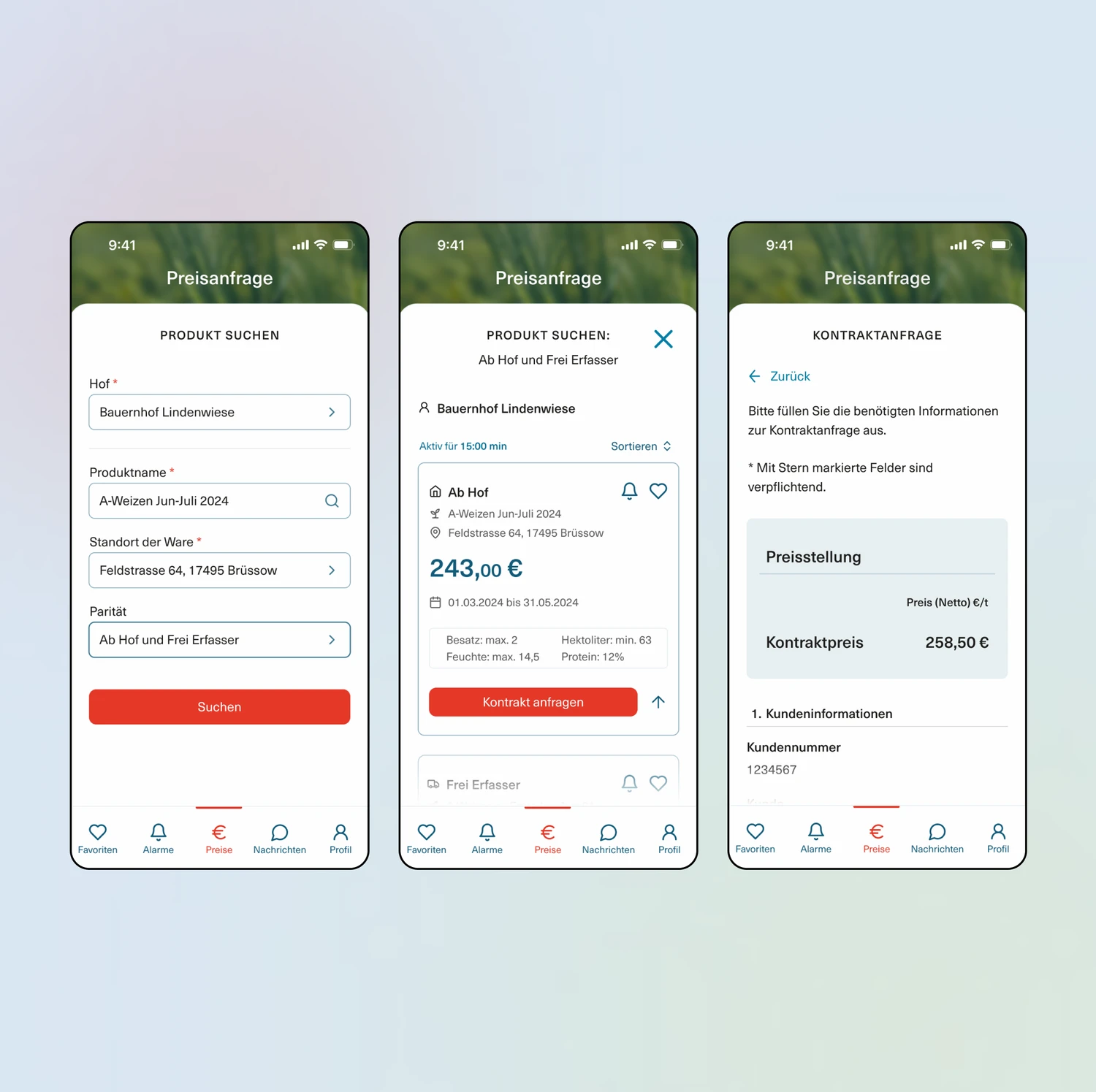
Farmers and Sales Reps' price request
THE PROBLEM
The platform treated each farm as a separate account. Farmers with two or three farms were logging in and out repeatedly throughout the day.
How do we make multi-farm management feel seamless without a data architecture redesign?
SOLUTION
Enable multi-farm management within a single account, working through technical feasibility and timeline together with PM, PO, and engineering leads.
BEFORE
Separate logins per farm
Long re-entry forms for each request
No price tracking or saved crops
Manual monitoring for optimal sell timing
AFTER
Seamless multi-farm management
Saved inputs and crop favoriting
One-tap price checks on daily products
Price tracking for optimal sell timing
TRADE-OFF
Farmer's account management
WE CHOSE
Multi-farm management in one account
Farmers with multiple operations could switch between farms without logging out. One session, full context — the friction that was costing them the most, gone.
VS
WE GAVE UP
Keeping the existing account model
Leaving the architecture untouched is easier. The farmers are used to logging in and out — annoying as it is — but that friction is worth fixing.
Traders' pricing workflow

THE PROBLEM
Each trader had developed their own workaround. The platform had accumulated 20 years of one-off features — creating inconsistency and a maintenance burden that slowed down every change.
How do we collapse 20 years of workarounds without losing what traders actually rely on?
SOLUTION
Consolidate product details, price lists, trading hours, and freight costs into a single sequential flow that reflects how traders actually make their decisions.
TRADE-OFF
Back-office contracts management

THE PROBLEM
Back-office agents were spending hours manually handling contracts through paperwork and phone calls. Going fully digital was the obvious solution — but obvious solutions in enterprise contexts often ignore the people around them.
How do we digitize a paper-based workflow that people have trusted for decades — without alienating them?
SOLUTION
Treat paper as a constraint to design around, not a problem to be eliminated. The primary workflow moved fully digital: faster approvals, a consolidated dashboard, clear status visibility. Paper contracts continued in parallel for record-keeping.
TRADE-OFF
Contract adoption
WE CHOSE
Digital-first, paper in parallel
Going fully digital for approvals and status tracking — but keeping paper contracts running alongside for record-keeping. Farmers who trusted paper weren't asked to give it up.
VS
WE GAVE UP
A clean break from paper
Eliminating paper entirely would have been a faster, simpler system. But for conservative users, familiarity is trust — and a forced switch risked adoption stalling before the benefits could land.
SYSTEM THINKING
Designed to scale, technically and operationally.
The platform needed to hold until 2030. Architecture, not just features, was what shaped decisions from day one.
Unified component library
Built on Ant Design and Tamagui — consistent patterns across web and native, reducing training and onboarding time.
Role-based architecture
Farmer, trader, back-office, and admin workflows separated by design — not just by navigation labels.
Mobile and low-bandwidth first
Farmers work in the field and sales reps are always on the go. Interfaces optimized for the conditions they're actually in.
One shared vocabulary
Internal teams used different terms for the same things. Standardized terminology and tooltips reduced confusion across every user group.
RESULTS & IMPACT
The redesigned platform became a core operational system right after launch.
WITHIN 6 MONTHS
€32.3M
in approved order value processed through the redesigned platform
WITHIN 3 WEEKS
500K+
price calculations processed — a volume the previous system couldn't handle reliably
WITHIN 60 DAYS
1,000+
digital contracts completed, one of BAT Agrar's key KPIs achieved
Beyond the numbers: operations and trading teams reported reduced cognitive load, faster workflows under peak seasonal demand, and — most importantly — increased trust in the system as a daily decision-making tool.
REFLECTION
Beyond producing solutions, my job as a designer is to design the conditions for the right ones to emerge.
Don't simplify away confidence.
Expert users need information density. The goal isn't fewer things on the screen — it's the right things, in the right moment.
Data makes the arguments you can't.
Rather than negotiating feature by feature, utilise user interviews and testings to decide if the extras were needed when users attempted real tasks.
Familiar patterns are part of the rollout strategy.
Conservative users equate familiarity with trust. Preserving patterns where they helped adoption is a strategy.
Design leadership isn't a title.
Mentoring a junior designer, running weekly design reviews, and shaping processes for cross-team visibility — that work made every other decision land better.

This is one of my favourite projects because it exemplified the kind of environment where great work happens. Setbacks were embraced as opportunities to improve, collaboration was effortless, and the expertise and professionalism created a strong foundation for success.
By the end of the engagement, our team, the client, and our engineering partner simply felt like one team working toward a shared goal. That experience, more than anything else, is what has stayed with me.